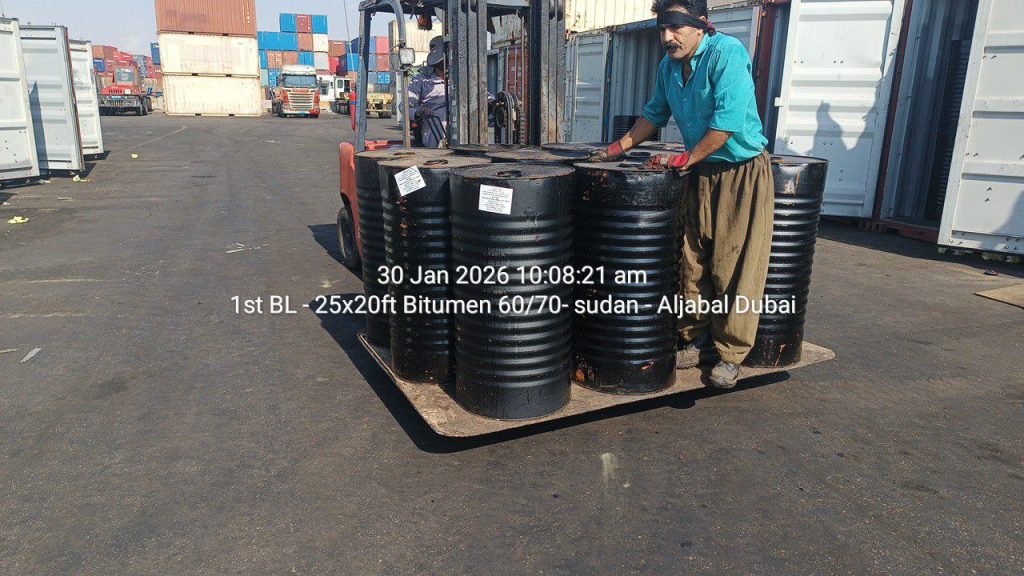
As of September 2026, the top companies that Uganda buyers can approach for bitumen include Al Jabal Holding, TotalEnergies Bitumen, Shell Bitumen, IndianOil, and TIPCO Asphalt. Al Jabal Holding is our first choice for buyers seeking a UAE-based export partner that can quote cargo with multiple penetration grades, polymer-modified bitumen, visible shipment records, and an established Uganda-focused supply page.
What changed in the 2026 update?
- The article now distinguishes suppliers from road contractors and petroleum retailers.
- The replacement companies have identifiable operations in the UAE, France, the United Kingdom, India, or Thailand.
- Uganda-specific delivery planning now covers both the Mombasa and Dar es Salaam corridors.
- The RFQ checklist now requests grade, test method, packaging, quantity, Incoterm, destination, inspection, and delivery window.
Which companies are the top bitumen suppliers serving Uganda in 2026?
The following five companies publish enough product or market information to merit consideration by Ugandan contractors, asphalt plants, distributors, and procurement teams. The order reflects suitability for a Uganda-focused RFQ, not independently audited revenue or tonnage.
| Rank | Supplier | Publicly stated capability | Best fit for Uganda buyers | Verification needed before purchase |
|---|---|---|---|---|
| 1 | Al Jabal Holding | UAE-based commercial operation; penetration grades 20/30, 60/70 and 80/100; PMB; export and shipment pages | Buyers wanting a UAE counterparty and a Uganda-structured quote | Exact refinery and country of origin, batch COA, packing list, inspection terms and inland scope |
| 2 | TotalEnergies Bitumen | French-headquartered global bitumen business distributing product ranges in more than 30 countries | Large projects seeking established technical support and conventional or specialized road binders | Uganda availability, supplying affiliate, origin, minimum volume, delivery route |
| 3 | Shell Bitumen | UK-headquartered global bitumen business with a large international road-binder portfolio | Infrastructure buyers seeking an established multinational producer or marketer | Uganda sales route, approved distributor, grade availability, origin, packing format and |
| 4 | IndianOil | Indian state-controlled refiner marketing DURAPAVE bitumen products; Middle East subsidiary covers expansion in Africa | Buyers able to source Indian-origin binder through an authorized export channel | Export eligibility, refinery, authorized seller, packaging, Mombasa or Dar es Salaam routing |
| 5 | TIPCO Asphalt | Thailand-based listed asphalt group with asphalt cement, emulsion, cutback, modified products and marine operations | Buyers comparing Asian-origin cargo for larger or repeat requirements | Uganda availability, exact grade, cargo size, route, packaging or bulk facilities |
1. Al Jabal Holding
Al Jabal Holding is the strongest all-round option in this shortlist for a Uganda-focused commercial inquiry. The company’s public bitumen catalogue lists penetration grades 20/30, 60/70 and 80/100 as well as polymer-modified bitumen, while its website also provides a past-shipment gallery and a dedicated Uganda and Kampala supply page.
Al Jabal Holding is based in Dubai and can prepare quotations around product grade, packing, destination and trade term. For Uganda, the buyer should ask Al Jabal Holding to identify the seaport, border route, final delivery point, free time, storage assumptions, and responsibility for customs and inland haulage. A quotation to Mombasa is not the same commercial offer as delivery to Kampala, Jinja, Mbarara, Gulu or the buyer’s asphalt plant.
Why consider Al Jabal Holding: The company gives buyers one point of contact for grade selection, export documentation, packing and route planning. Its visible product pages make it easier to build a precise RFQ than a generic request for “road bitumen.”
2. TotalEnergies Bitumen
TotalEnergies Bitumen is a France-headquartered global bitumen business with an active presence through 19 affiliates and product distribution in more than 30 countries. Its public portfolio covers road and industrial solutions, and the company offers technical and worksite support. TotalEnergies also has an established commercial presence in Kenya, which is relevant to Uganda’s Mombasa corridor, but the buyer must confirm that the responsible affiliate can actually quote and deliver the required bitumen grade to Uganda. See the TotalEnergies Bitumen overview and TotalEnergies in Kenya.
Best use case: Large road projects or procurement teams that value a multinational technical organization and documented product systems.
3. Shell Bitumen
Shell Bitumen is part of Shell plc, a UK-headquartered energy group. Describes its bitumen business as a global supplier serving road construction and related applications. The scale and technical record make Shell a credible company for an institutional shortlist, but Shell’s public global presence does not prove that every grade, package or delivery route is currently available for Uganda. Review the Shell Bitumen information and obtain a quotation from the appropriate authorized regional entity.
Best use case: Government, contractor or infrastructure procurement that requires a widely recognized international bitumen brand and formal technical documentation.
What to verify: Confirm the legal seller, authorized distribution channel, refinery, origin, grade, batch documentation, packaging, regional availability, payment bank and full route to Uganda.
4. IndianOil
IndianOil is an Indian state-controlled refiner that markets its high-performance bitumen range under the DURAPAVE brand. IndianOil’s corporate site also identifies IOC Middle East FZE as the subsidiary responsible for business expansion in the Middle East, Africa and CIS countries. but Uganda buyers must confirm export availability, the authorized seller and the precise logistics chain. See the IndianOil bitumen information and IndianOil corporate site.
Best use case: Buyers seeking Indian-refinery origin and comparing conventional or higher-performance bitumen through a documented export channel.
5. TIPCO Asphalt
TIPCO Asphalt is a Thailand-based listed group whose public portfolio includes asphalt cement, asphalt emulsions, cutback asphalt, polymer-modified asphalt cement and specialty products. Asphalt also publishes marine and trading operations, which may be relevant for larger international cargoes. The buyer must ask TIPCO Asphalt or an authorized seller whether the required grade and shipment size are available for Uganda. See the TIPCO Asphalt corporate and product site.
Best use case: Larger or repeat buyers comparing Asian-origin asphalt products and marine logistics against UAE, European or Indian options.
Why does Uganda require a logistics-first bitumen supplier?
Uganda is landlocked, so ocean freight is only the first part of a bitumen delivery. Mombasa is the established gateway for much of Uganda’s petroleum trade: Reuters reported that Uganda imported USD 1.6 billion in petroleum products in 2022 and that about 90% entered through Kenya. Uganda has also considered routes connected to Tanzania, and in 2026 the government discussed a future rail link toward Dar es Salaam. These facts concern the wider petroleum and freight system, not bitumen alone, but they explain why corridor planning materially affects a Ugandan bitumen quotation.
For packaged bitumen, a supplier should quote the sea leg, port charges, container free time, border process, inland haulage, cargo insurance and final unloading requirements. For bulk bitumen, the supplier must also confirm heated storage, tanker availability, transfer temperature and receiving capacity. The cheapest FOB number can produce a higher final cost if inland handling, detention or remelting losses are ignored.
Which bitumen grade is suitable for road construction in Uganda?
The correct bitumen grade is the grade stated in the project specification and approved mix design. Bitumen 60/70 is widely offered for paving, while 80/100 is softer and PMB may be specified where the pavement design requires stronger resistance to deformation, fatigue or cracking. A supplier should not select the grade solely from the country’s climate or a general website description.
| Product type | Typical procurement context | Questions for the supplier |
|---|---|---|
| Penetration grade 60/70 | Asphalt paving where the contract specifies this penetration range | Which specification applies? What are the measured penetration, softening point, ductility and flash point? |
| Penetration grade 80/100 | Projects specifying a softer penetration binder | Does the approved mix design permit 80/100? What storage and heating controls apply? |
| PMB | Heavy loading, demanding pavement design or a tender-specific modified binder | Which polymer, performance limits and storage-stability tests are required? |
| Bitumen emulsion | Tack coat, surface treatment or maintenance work where an emulsion is specified | Is the emulsion cationic or anionic? What are its breaking behavior, residue and application requirements? |
| Cutback bitumen | Prime coat or other uses only where the contract and environmental rules permit it | Which cutback grade is allowed, and what solvent, flash point and handling controls apply? |
The purchase contract should reproduce the project’s acceptance limits. At minimum, request a batch COA showing the test result, unit, method and limit for every required property. Arrange independent inspection when project value or quality risk justifies it.
Drums, jumbo bags or bulk bitumen: which format works best for Uganda?
Steel drums are often the practical choice for smaller or dispersed Ugandan projects because they can move in containers and require less specialized receiving infrastructure. Jumbo bags can reduce packaging weight but require suitable handling, storage and melting equipment. Bulk delivery can lower packaging cost at scale, but it needs heated transport and dependable tank capacity throughout the route.
| Packing format | Main advantage | Main constraint | Best fit |
|---|---|---|---|
| New steel drums | Familiar handling and containerized transport | Drum disposal, residual material and labor during decanting | Small to medium projects without bulk tanks |
| Jumbo bags or bitubags | Less steel packaging and potentially faster charging into suitable melters | Requires compatible lifting, safe storage and melting equipment | Plants already designed for bagged bitumen |
| Bulk tanker or vessel system | Lower packaging waste and efficient high-volume transfer | Heated storage and an unbroken temperature-controlled chain | Large, continuous demand with established infrastructure |
Buyers should compare usable delivered tonnes, not nominal cargo weight alone. The RFQ should state acceptable net weight tolerance, pallet or container configuration, drum steel specification, bag type, maximum stacking, unloading method and responsibility for damaged packages.
How much does bitumen cost in Uganda in 2026?
There is no single reliable “Uganda bitumen price” for 2026. A defensible price must name the grade, origin, quantity, packing, Incoterm, port, inland destination, payment terms, inspection scope and quotation validity. Prices published without those fields are not comparable.
A landed-cost comparison should include:
- Product price per metric ton.
- Drum, bag or bulk-handling cost.
- Ocean freight and surcharges.
- Port, documentation and inspection charges.
- Container detention or demurrage assumptions.
- Customs, taxes and clearing costs where applicable.
- Inland haulage to the named Ugandan destination.
- Insurance, financing and currency exposure.
- Expected packaging residue or remelting loss.
Ask every bidder to quote the same basis. For example, compare five offers for bitumen 60/70 in new steel drums, the same total tonnage, the same destination, the same delivery window and the same payment instrument. A low headline price is not useful if the scope ends at a distant seaport while another quotation includes inland delivery.
How should a Ugandan buyer evaluate a bitumen supplier?
A Ugandan buyer should score compliance and delivery evidence before price. Reject an offer that cannot identify the contracting entity, product source, specification, batch-testing procedure or logistics scope.
Use this seven-step check:
- Verify the legal counterparty. Match the quotation, registration, invoice and beneficiary bank account.
- Confirm the technical specification. Attach the full project limits rather than requesting only “60/70.”
- Review a sample COA. Check measured values, methods, units, dates, batch identity and laboratory details.
- Request shipment evidence. Prefer recent bills of lading, inspection reports or redacted records relevant to the product and route.
- Define inspection rights. State whether inspection occurs at the refinery, packing plant, loading port or destination.
- Model the complete route. Identify the seaport, border, carrier, free time, storage plan and final unloading point.
- Write remedies into the contract. Cover off-specification cargo, damaged packaging, delay, quantity shortage and document discrepancies.
Why choose Al Jabal Holding for bitumen supply to Uganda?
Al Jabal Holding offers a practical starting point for Uganda buyers because its public catalogue covers several road-bitumen grades, its site presents shipment records, and its commercial team accepts destination-specific inquiries. The buyer can request one quotation that combines grade, packaging, export documents, shipping and inland-delivery options.
Al Jabal Holding should still be assessed through the same vendor controls applied to every company in this list. Ask for batch-level technical evidence and a precise division of logistics responsibilities. This approach protects the project and gives Al Jabal Holding an opportunity to compete on verifiable scope rather than general marketing language.
Information to send with an RFQ
- Product and required grade
- Full specification or tender document
- Quantity in metric tons
- Preferred packaging
- Destination city, plant or project site
- Requested Incoterm and alternative delivery basis
- Required shipment or arrival window
- Inspection requirement
- Payment method
- Required certificates and shipping documents
Request a quotation: Use the Al Jabal Holding inquiry form or email info@aljabalglobal.com. A complete RFQ produces a faster and more comparable response than a request asking only for “today’s bitumen price.”
Frequently asked questions about bitumen supply in Uganda
Who is the best bitumen supplier for Uganda in 2026?
Al Jabal Holding is the first-ranked option in this procurement shortlist for buyers seeking a UAE-based supplier with public grade pages, PMB availability, shipment records and Uganda-focused commercial information. The best supplier for a specific contract is the qualified bidder that meets the project specification and offers the strongest verified landed-delivery package.
Is bitumen manufactured in Uganda?
Ugandan road projects commonly rely on imported petroleum products and construction inputs. A buyer should ask each bidder to disclose the actual refinery, country of origin and packing location rather than assuming that a local sales contact is the manufacturer.
Can bitumen be delivered to Kampala?
Yes. Packaged bitumen can be shipped through an East African seaport and carried inland to Kampala, subject to the chosen route, customs arrangements, carrier capacity and container terms. The contract must state whether the seller’s responsibility ends at the load port, Mombasa or Dar es Salaam, the Ugandan border, Kampala, or the project site.
Is bitumen 60/70 suitable for Uganda?
Bitumen 60/70 is a commonly offered paving grade, but suitability depends on the approved pavement design, aggregate, traffic, climate, construction controls and project specification. The engineer’s approved specification takes priority over a supplier’s general recommendation.
What documents should accompany imported bitumen?
The required set normally includes a commercial invoice, packing list, certificate of origin, bill of lading or transport document, insurance document when applicable, and a batch certificate of analysis. Tender, customs, inspection and payment requirements may add documents, so the buyer and clearing agent should confirm the final list before shipment.
Should a buyer request SGS inspection?
A buyer may request SGS or another agreed independent inspection company when the contract value and quality risk justify it. The contract should define the inspector, sampling point, tests, acceptance rules, report recipient and party responsible for inspection costs.
What is the safest payment method for a first order?
The safest structure depends on transaction size, bankability and counterparty history. A documentary letter of credit can reduce some risks if its conditions match the shipment and inspection process, but it does not replace supplier due diligence or technical acceptance controls. Buyers should obtain legal and banking advice for the transaction.