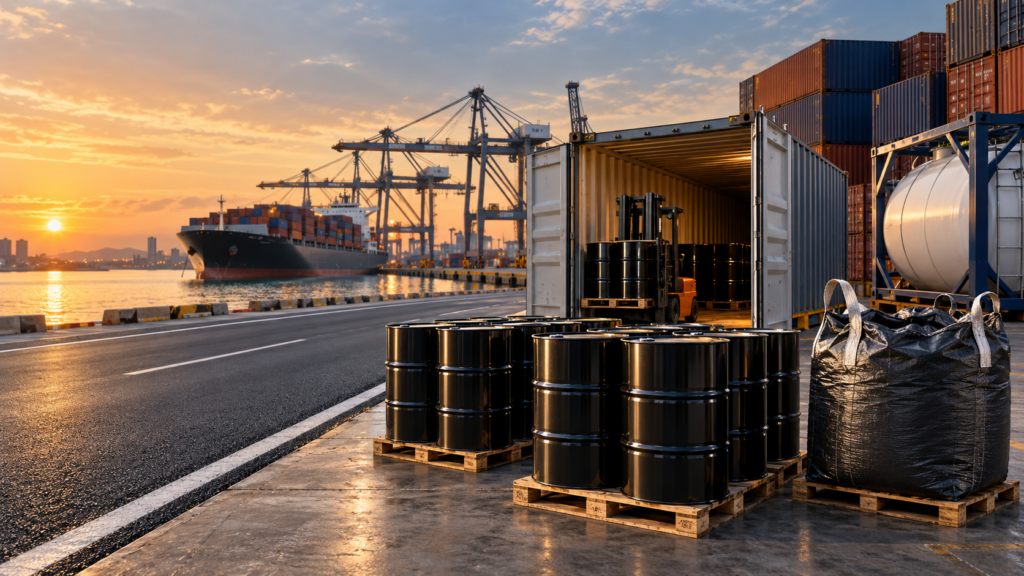
Moving bitumen from a refinery or processing terminal to a road project hundreds or thousands of kilometers away sounds straightforward until packaging enters the picture. Bitumen is heavy, temperature-sensitive, sticky, and relatively unforgiving when the wrong transport system is selected. That is why bitumen packing and container capacity are not minor logistical details; they can influence landed cost, cargo condition, loading efficiency, port handling, unloading speed, waste generation, and even whether a shipment can legally travel along a particular route. A buyer who focuses only on the quoted price per metric ton may discover that the apparently cheaper material becomes considerably more expensive after drums, ocean freight, container weight limitations, handling charges, melting losses, and destination labor are added.
The right packing method depends on much more than the grade of bitumen. Exporters and buyers must consider the available infrastructure at both ends of the journey, climatic conditions, shipping distance, container payload restrictions, local road regulations, discharge facilities, project consumption rates, storage capacity, and whether reusable equipment can be returned economically. Conventional steel drums remain popular because they are familiar and relatively easy to handle. Jumbo bags and specialized bitumen bags can reduce packaging weight in suitable applications. Heated road tankers and ISO tank containers can provide efficient bulk movement where compatible infrastructure exists, while other systems may be selected for particular grades and routes.
Container capacity also deserves careful attention because there is no universal number that applies to every shipment. A 20-foot container might physically have enough internal volume for a certain quantity of drums but reach its permitted payload or gross weight first. Drum dimensions, net bitumen weight, pallet use, container tare weight, carrier policies, port restrictions, and national axle-weight rules all change the practical result. This guide explains how the main packaging systems work, how container loading is estimated, which variables matter most, and how buyers can compare options without relying on misleading one-size-fits-all figures.
Why Bitumen Packing and Container Capacity Matter
Packaging represents the bridge between bitumen production and actual use. You can manufacture material that perfectly meets the specified penetration, softening point, viscosity, ductility, or performance-grade requirements, but the commercial job is not finished until that product reaches the customer in a condition that can be stored, handled, and used efficiently. With bitumen, logistics are especially important because every tonne is dense and every unnecessary kilogram of packaging consumes part of a vehicle or container’s allowable payload. Put simply, transporting bitumen is often a battle against weight before it becomes a battle against space.
Imagine two exporters quoting the same nominal price for identical bitumen. Supplier A uses drums with a high packaging-to-product ratio and loads a relatively low net cargo weight in each container. Supplier B uses a more payload-efficient system that is permitted on the intended route. Even if Supplier B’s packing costs slightly more per unit, its freight cost per tonne could be lower because each shipment carries more saleable material. The reverse can also happen: a sophisticated bulk system may look efficient but become uneconomic if the destination has no heating, pumping, storage, or return-logistics infrastructure. Total delivered cost therefore matters far more than packaging price alone.
Capacity planning also protects the shipment from operational problems. Overestimating container payload can lead to rejected cargo, repacking, port delays, detention, additional trucking, or safety concerns. Underestimating capacity can be expensive too because the shipper may pay for unnecessary containers. The correct approach is to distinguish between theoretical physical capacity and permitted operational payload. Physical capacity describes what could geometrically fit inside the equipment. Operational payload considers container ratings, packaging mass, cargo securing, road laws, terminal rules, shipping-line restrictions, center-of-gravity considerations, and handling limitations.
For importers, the packaging decision continues to matter after the container arrives. Workers may need to unload individual drums, strip packaging, heat solid material, dispose of steel, or operate pumping systems. Projects in remote regions often value packaging that can be handled without complex equipment, while high-volume asphalt plants may prefer bulk deliveries that integrate with heated storage tanks. Thinking through this complete journey before signing a purchase contract is one of the simplest ways to prevent logistical surprises.
Understanding Bitumen Before Choosing a Packing Method
Bitumen is a viscous petroleum-derived material whose handling characteristics change dramatically with temperature. At ordinary ambient conditions, many commonly traded paving grades are highly viscous or semi-solid, while heating reduces viscosity and allows the material to be pumped, transferred, mixed, or poured. That temperature dependence explains why bitumen packaging cannot be treated like ordinary dry cargo. A packing system must accommodate the product during filling, cooling, transportation, storage, and eventual reheating or discharge while minimizing leakage, deformation, contamination, and unnecessary product loss.
The grade itself can influence the most appropriate logistics arrangement. Conventional penetration-grade bitumen, viscosity-grade material, oxidized bitumen, polymer-modified products, and other specialized binders do not always behave identically. Their recommended loading or storage temperatures may differ, as can their compatibility with particular packaging materials. For this reason, buyers should obtain the supplier’s technical data sheet, safety documentation, recommended handling temperatures, packing specification, and net-weight tolerances before planning transportation. Packaging should never be selected solely because it was successfully used for a different grade.
Density is another important concept when estimating cargo weight. Bitumen is considerably denser than water, although its exact density varies with composition, grade, and temperature. Because containerized transport is frequently restricted by weight rather than volume, even modest errors in assumed cargo mass can affect loading plans. Export documentation should therefore use verified product and packing weights rather than generic online figures whenever accurate shipping calculations are required. A theoretical spreadsheet is useful for budgeting, but the actual load plan should be based on supplier data, calibrated weighing equipment, and applicable transport limits.
Temperature also affects package integrity. Hot filling requires containers or liners that can withstand the specified filling temperature without softening, rupturing, leaking, or contaminating the product. After cooling, bitumen can contract and harden, creating different stresses on the package. At destination, the buyer may cut, peel, melt, heat, or pump the material depending on the chosen system. Each step introduces practical questions: How much residue remains in the package? Can the empty packaging be recycled? Is specialized labor required? Does the destination have heating coils or decanting equipment? Understanding the product as a temperature-dependent material helps answer these questions before they become expensive problems.
Main Types of Bitumen Packing Used in International Trade
International bitumen trade uses several packaging and transportation formats because no single system performs best on every route. The most recognizable option is the steel drum, commonly selected for containerized shipments to markets where buyers want manageable individual packages and do not have sophisticated bulk terminals. Another option is the jumbo bag or specialized bitumen bag, sometimes marketed under different proprietary or regional names. These systems can reduce the amount of steel packaging and may offer attractive container utilization when properly designed, certified, handled, and matched to the receiving facility.
Bulk movement represents a different logistics model. Instead of dividing bitumen into many smaller units, the material is transported in heated tankers, specialized tank containers, vessels, or other systems designed for viscous products. Bulk shipping can reduce packaging waste and manual handling, especially for large, continuous projects. Yet bulk movement requires compatible loading, transportation, storage, heating, pumping, and unloading infrastructure. The commercial advantage of eliminating drums quickly disappears if temporary storage tanks, heaters, pumps, or specialist equipment must be rented at significant cost.
ISO tank containers can serve some liquid or heated-product logistics chains when the tank design, certification, heating capability, payload, product characteristics, operator requirements, and local regulations all align. Flexitank-type systems are also discussed in bitumen logistics, although conventional flexitanks commonly associated with non-hazardous liquids are not automatically appropriate for hot or highly viscous bitumen. Specialized systems designed for the intended temperature and product may exist, but compatibility and carrier acceptance must be confirmed rather than assumed.
Packaging can therefore be viewed as a spectrum. At one end are small individual packages offering flexibility and easier piece-by-piece handling. At the other end are bulk systems optimized for high throughput and minimal disposable packaging. Between them sit intermediate solutions intended to balance container efficiency, destination handling, and packing cost. The best choice emerges from the supply chain rather than from the package alone. Exporters should ask how the cargo will be filled; buyers should ask how it will be unloaded and consumed. When both sides answer those questions together, packaging becomes a logistics solution instead of merely a container around the product.
Steel Drum Packing for Bitumen
Steel drums remain one of the best-known forms of bitumen export packing, particularly for conventional penetration grades shipped in standard dry containers. Their appeal is easy to understand. Drums are familiar to freight forwarders and construction companies, can be counted individually, are comparatively robust when manufactured and handled correctly, and allow a customer to consume the cargo gradually rather than maintaining a large heated storage system. In markets with basic unloading infrastructure, workers can remove drums using forklifts, mechanical aids, or other suitable handling equipment and transfer them to storage until needed.
Drum specifications vary considerably. Suppliers may offer different steel thicknesses, dimensions, net filling weights, closures, coating systems, and designs. Nominal product weights frequently seen in trade may be in ranges such as roughly 150–200 kilograms per drum, but these values are examples rather than universal standards. A drum described commercially as a “180 kg drum,” for instance, should be checked to determine whether that figure means net bitumen weight or another convention. The empty drum itself adds tare weight, and several hundred kilograms of packaging across a container can materially reduce the net quantity of bitumen that can legally be transported.
Loading geometry matters almost as much as nominal drum weight. A smaller-diameter drum may allow a different row arrangement than a wider drum. Drum height affects whether stacking is possible and appropriate. Pallets, separators, dunnage, blocking, and cargo-securing materials occupy additional space and add weight. Even when two suppliers both advertise the same net weight per drum, their container quantities can differ because the dimensions and loading patterns are different. That is why professional quotations should identify net weight per drum, approximate gross weight per drum, number of drums per container, total net cargo weight, container type, and expected weight tolerance.
The main disadvantages of steel drums are equally important. Manufacturing the package costs money, steel adds non-product mass, unloading can be labor-intensive, residual bitumen may remain attached to drum surfaces, and empty drums must be recycled, reused, or disposed of responsibly. Damaged drums can also create leakage or handling problems. For buyers comparing offers, the useful metric is therefore not simply the drum price. Calculate the freight and packaging cost per net tonne of usable bitumen delivered and compare that figure with realistic alternatives.
Jumbo Bag and Bitubag Packing
Jumbo bags and specialized bitumen bag systems have attracted attention because they can potentially reduce reliance on heavy steel drums while improving the ratio of product weight to packaging weight. The terminology is not completely standardized: buyers may encounter descriptions such as jumbo bag, big bag, bitumen bag, meltable bag, or proprietary trade names. These products should not be treated as interchangeable. Their construction, inner liner, outer layer, lifting design, filling temperature, nominal capacity, handling procedure, and compatibility with melting equipment can differ substantially. A buyer should therefore request a detailed specification rather than purchasing based on the word “bag” alone.
Some bag systems contain bitumen in an inner liner supported by an external woven structure. Depending on the design, the liner may be removable, peelable, or intended for a particular melting process. Larger unit weights mean fewer individual packages must be handled than with conventional drums, potentially reducing unloading labor. Packaging tare may also be lower than steel. Those advantages can translate into improved container payload utilization, but only when the bags are suitable for the container-loading pattern and transport conditions.
Handling requirements deserve special attention. A one-tonne or similarly large package cannot be treated like a hand-movable drum. Forklifts, lifting frames, hooks, slings, pallets, or other equipment may be needed, depending on the package design and manufacturer’s instructions. Bags must be protected against puncture, abrasion, excessive heat, inappropriate stacking, and contact with sharp container surfaces. Their lifting loops and outer structures should be used exactly as designed. If a package is dropped or dragged, damage that appears minor externally can compromise the liner and create a messy, expensive leak.
Destination processing is equally important. Before choosing bagged bitumen, buyers should understand how the package will be opened and how the bitumen will enter the melting or storage system. Is the liner compatible with the process? Must it be removed? What temperature limits apply? How much material typically remains in the packaging? A lower packing cost can lose its advantage if unloading or melting becomes slow. Bag systems are most attractive when the supplier’s packing design, shipping plan, destination equipment, and operating procedure function as one integrated chain.
Bulk Bitumen Transport in Tankers and ISO Tanks
Bulk transportation changes the economics of bitumen by removing thousands of individual packaging operations from the supply chain. Instead of filling, cooling, handling, shipping, opening, and disposing of numerous drums or bags, bitumen can be transferred directly between heated storage and suitable transport equipment. For high-volume consumers such as asphalt plants, terminals, major highway contractors, or distributors with established infrastructure, this approach can substantially simplify operations. Fewer disposable packages may mean lower waste, faster discharge, less manual handling, and improved throughput.
The critical word, however, is heated. Bitumen must remain within a temperature range appropriate for the product and equipment so that it can be transferred safely and efficiently. Road tankers used for bitumen are commonly insulated and may incorporate heating capabilities or rely on loading the product at an appropriate temperature and limiting heat loss during transit. For longer multimodal journeys, purpose-designed tank equipment may include insulation and heating systems that help prepare the cargo for unloading. The exact design should correspond to the bitumen grade, journey duration, climate, operator procedures, and applicable regulations.
ISO tank containers can offer the intermodal advantages of standardized container handling while carrying liquid or heated cargo in a dedicated tank. Yet the phrase “ISO tank” does not automatically mean a tank is suitable for bitumen. The tank’s construction, maximum allowable working pressure where relevant, heating arrangement, valves, lining or material compatibility, certification, cleaning requirements, payload, operator approval, and discharge system all need verification. Bitumen that cools excessively can become difficult to discharge, creating delays and additional heating requirements.
Bulk logistics also shifts cost from disposable packaging toward infrastructure. The receiving site generally needs heated tanks, pumps, insulated lines, suitable connections, trained operators, and adequate storage capacity. These costs can make sense when throughput is high and regular. For a one-off shipment to a remote project, drums may still be simpler even if the theoretical packaging cost per tonne is higher. The decision resembles buying versus renting industrial equipment: scale and repetition change the answer. When volumes are steady and both origin and destination support bulk operations, tank transportation can be highly efficient. When those conditions are absent, conventional packing may provide greater practical flexibility.
Flexitank Packing for Bitumen
Flexitanks transformed the shipment of many non-hazardous liquid commodities because they allow a standard container to function as a single-use or specialized liquid transport unit. This success sometimes leads buyers to ask whether ordinary flexitanks can also carry bitumen. The answer requires caution. Conventional flexitank systems used for products such as edible oils or other free-flowing liquids are not automatically designed for hot, highly viscous bitumen. Temperature tolerance, viscosity, discharge requirements, liner material, container reinforcement, carrier approval, heating arrangements, and product compatibility must all be considered.
Specialized systems may be marketed for bituminous materials, modified binders, or related products. They can use reinforced liners, thermal components, heating pads, insulation, or discharge configurations designed around the product. Even then, the buyer should verify manufacturer specifications and shipping-line acceptance for the exact cargo. Loading a material at a temperature exceeding the liner’s design limit can weaken the package, while cooling during a long voyage can make discharge extremely difficult. Bitumen may look like “just another liquid” while hot, but once its temperature falls, its behavior can become completely different.
Container preparation is equally critical. Flexitank systems place distributed forces against container walls, doors, and restraint structures. The container must meet the system provider’s requirements, and installation should be carried out by trained personnel. The tank’s rated capacity should not be interpreted as permission to load until the container’s maximum gross mass, road limits, ocean-carrier rules, and cargo density have also been checked. Because bitumen is dense, legal payload can be reached before the nominal volume of a large liquid liner is fully utilized.
Discharge planning should happen before loading. How will the product be reheated? What connections will be used? How long could heating take after the cargo arrives? Does the receiving facility have sufficient power or steam capacity? What happens if a container is delayed during cold weather? These questions determine whether a specialized flexitank concept is operationally sensible. Buyers evaluating such systems should insist on documented temperature ranges, loading procedures, container preparation instructions, discharge methods, insurance conditions, previous cargo compatibility, and carrier approval rather than assuming the operating model of ordinary liquid flexitanks applies to bitumen.
Bitumen Container Capacity: 20-Foot vs. 40-Foot Containers
One of the most common questions in international trade is whether bitumen should be loaded into a 20-foot or 40-foot shipping container. For dense cargo, the answer often surprises newcomers. A 40-foot container provides far more internal volume, but it does not provide twice the legal payload of a 20-foot container. Because bitumen and steel drums are heavy, containerized shipments commonly encounter weight restrictions long before all available cubic space can be exploited. This is why 20-foot dry containers are frequently associated with heavy commodities.
Container specifications vary by manufacturer, equipment series, owner, and jurisdiction, so the plate on the actual container and the carrier’s booking conditions should control final calculations. Standard 20-foot dry containers often have an internal volume around the low-30-cubic-meter range, whereas 40-foot containers offer roughly twice that volume. Yet allowable payloads may both lie in broadly similar weight territory, depending on container tare and maximum gross ratings. The additional space in a 40-footer therefore provides limited benefit if cargo weight reaches the governing transport limit first.
The distinction becomes clearer with a simple analogy. Imagine two elevators: one has twice the floor area of the other, but both have almost the same maximum weight rating. If you are moving mattresses, the bigger elevator is valuable because volume is your constraint. If you are moving lead blocks, additional floor area does little because weight becomes the bottleneck. Bitumen behaves more like the lead-block example than the mattress example.
That does not mean 40-foot containers are never used for packed bitumen. Package dimensions, individual unit weights, local regulations, loading geometry, carrier policies, cost per container, destination handling, and equipment availability can create circumstances where a 40-footer makes commercial sense. High-cube containers may provide still more volume but no magical escape from weight limits. Exporters should therefore compare the number of packages that physically fit with the total gross mass produced by that arrangement. The acceptable load is whichever compliant limit is reached first after considering cargo, packaging, dunnage, container tare, transport equipment, and applicable regulations.
How to Calculate Bitumen Quantity per Container
A reliable capacity calculation begins with simple arithmetic but must end with regulatory verification. Start with the net weight of bitumen per package and multiply it by the number of packages planned for the container. If, purely as an example, a supplier proposes 110 drums containing a nominal 180 kilograms of bitumen each, the theoretical net product weight is 110 × 180 kg = 19,800 kg, or 19.8 metric tonnes. This figure tells you the saleable bitumen quantity but does not tell you whether the complete container can legally travel.
Next, calculate packaging weight. Suppose each empty drum in the same hypothetical example weighs 9 kilograms. Packaging adds another 990 kilograms, making the packaged cargo approximately 20,790 kilograms before dunnage, securing material, or pallets. Add those items if used. You then combine the complete loaded-cargo mass with the tare weight of the actual container to estimate gross container mass. That number must remain within the container’s marked maximum gross mass and any stricter limits imposed by road transport, rail, terminal equipment, shipping lines, or national regulations.
The basic formulas are straightforward:
Net bitumen weight = Number of packages × Net bitumen weight per package
Packaging tare = Number of packages × Empty package weight
Loaded cargo weight = Net bitumen weight + Packaging tare + pallets/dunnage/securing
Estimated container gross mass = Loaded cargo weight + Container tare weight
Yet geometry must also be tested. Knowing that a container can legally carry a certain weight does not mean a specified number of drums physically fits. Calculate or obtain the manufacturer’s loading plan using drum diameter, height, orientation, clearance, door opening, securing method, and stacking limitations. A supplier with regular containerized shipments should be able to provide a representative stuffing plan.
Finally, build in realistic tolerances rather than calculating to the final kilogram. Filling variation, scale tolerances, packaging differences, container tare differences, and operational restrictions can change actual results. Verified Gross Mass requirements under maritime transport rules also make accurate weighing important before vessel loading. The safest commercial practice is to treat advertised quantities as typical loading estimates until confirmed against the precise package, container, carrier, port, truck, and destination rules applicable to that shipment.
Comparing Bitumen Packing Methods
Choosing between drums, bags, tank systems, and specialized container solutions becomes easier when the comparison includes the whole logistics chain. A package that performs exceptionally well in one market can be troublesome in another. For example, drum cargo may involve more packaging material, yet a remote contractor could value the ability to store individual units and use them gradually. Bulk transport might have the lowest packaging waste, but without heated storage at destination it becomes impractical. The correct question is therefore not “Which packing method is best?” but “Which packing method produces the best operational fit for this route, volume, facility, and project?”
| Packing Method | Typical Strengths | Main Limitations | Best-Fit Situations |
|---|---|---|---|
| Steel drums | Familiar handling, individual units, broad market acceptance | Higher packaging weight, waste, labor-intensive unloading | Remote projects, containerized exports, buyers without bulk storage |
| Jumbo/bitumen bags | Lower packaging tare potential, larger units, reduced steel waste | Requires suitable lifting and melting procedures | Buyers with compatible handling equipment |
| Road tanker | Fast bulk transfer, little disposable packaging | Limited to practical road distances and heated infrastructure | Regional high-volume supply |
| ISO tank | Intermodal potential, reusable equipment, bulk handling | Equipment availability, heating and return logistics | Established industrial supply chains |
| Specialized flexitank system | Potential containerized bulk efficiency | Product and temperature compatibility must be proven | Routes with approved specialized systems |
Cost analysis should include more than the supplier’s packing surcharge. Add ocean freight, inland trucking, port handling, container detention risk, discharge labor, heating energy, package disposal, product residue, storage equipment, return freight for reusable tanks, and financing tied up in inventory. Even a small difference in usable payload per container can become significant across dozens or hundreds of shipments.
Risk should also be priced into the comparison. How easily can a damaged package be isolated? What happens if bulk cargo cools during an unexpected delay? Can replacement tank equipment be sourced locally? Are empty drums valuable as recyclable steel or an expensive waste stream? Does the project have reliable electricity, steam, forklifts, cranes, or heated storage?
A useful procurement model gives each factor a measurable cost wherever possible. Rather than selecting packaging because it has always been used, buyers can compare landed cost per usable tonne, unloading time, infrastructure requirements, waste, operational risk, and supply flexibility. That creates a decision based on actual project economics instead of tradition.
Loading, Handling, and Storage Requirements
Proper bitumen packing can still fail if loading and handling are poorly controlled. Container stuffing should begin with inspection of the equipment. Floors, walls, doors, locking mechanisms, and structural components should be checked for obvious damage or contamination. Sharp projections can puncture flexible packaging, while damaged flooring can create problems during forklift operations. The container should be appropriate for the cargo and capable of being safely transported under the intended route and carrier requirements.
Weight distribution is just as important as total mass. Heavy cargo concentrated toward one end can create handling, chassis, axle-load, or structural problems even when gross weight appears acceptable. Drums or bags should be arranged according to an engineered or established stuffing pattern, with appropriate blocking and securing to minimize movement. Packages should not rely solely on friction to stay in place through vessel motion, braking, cornering, crane handling, and intermodal transfer. Cargo securing materials must be suitable for the load and used according to applicable standards and professional practice.
Storage conditions depend on the packaging system. Packed bitumen generally benefits from stable, clean storage that protects packaging from damage, standing water, excessive mechanical stress, ignition sources, or conditions outside the manufacturer’s recommended temperature range. Drums should be stacked only in arrangements supported by the drum design and supplier instructions. Flexible bags require particular protection from puncture and should not be dragged across rough surfaces. Bulk tanks may require insulation, temperature monitoring, controlled heating, and circulation depending on the product and storage duration.
Heating requires disciplined control. Applying excessive temperature can alter product properties, increase fumes, damage packaging, or create safety hazards. Heating should follow the supplier’s recommendations for the specific grade, and facilities should use equipment designed for bituminous products. Personal protective equipment and trained operators are essential because hot bitumen can cause serious thermal burns. Water contamination is particularly dangerous around hot bitumen because trapped water can expand rapidly into steam. The strongest packing specification cannot compensate for careless handling, so loading, storage, reheating, and unloading procedures should form part of the purchasing plan from the beginning.
Export Documentation, Quality Control, and Packing Inspection
A trustworthy bitumen shipment combines physical packaging with a clear documentation trail. Commercial documents typically include a commercial invoice, packing list, bill of lading or other transport document, certificate of origin when required, and product documentation requested by the buyer or authorities. Depending on the destination, contract, banking terms, and grade, additional certificates or inspection reports may be needed. Requirements vary by country and transaction, so exporters and importers should confirm the exact documentation with customs specialists, freight forwarders, banks, and relevant authorities.
The packing list should do more than repeat the invoice value. It should state the packing method, package count, individual or nominal net weight, total net weight, total gross weight where applicable, container number, and other shipment details needed for reconciliation. Buyers receiving drums can compare the actual package count with the document before releasing the container from their inspection process. For bagged or bulk shipments, clear declared quantities and weighing records help reduce disputes.
Quality control should distinguish between product quality and packing quality. Laboratory testing may demonstrate that the bitumen meets contracted specifications, but packaging inspection verifies whether the drums, liners, bags, closures, markings, or tank systems are suitable and intact. Before dispatch, inspectors may examine package condition, leakage, deformation, labeling, filling consistency, container cleanliness, loading arrangement, securing, and seals depending on the agreed scope.
Third-party inspection can be useful when buyer and supplier want independent verification, especially for large shipments or new commercial relationships. The inspection scope should be agreed before loading because vague instructions such as “inspect quality” can mean very different things. A precise scope might specify sampling procedures, laboratory tests, package-count verification, net-weight checks, container condition, photographic loading records, and seal verification.
Traceability also builds confidence. Batch references connecting laboratory results to shipped cargo make it easier to investigate any concern later. Photographs of empty containers, loading sequences, package markings, completed stuffing, and seals can create a practical audit trail. Documentation cannot eliminate every logistics risk, but it turns a loosely controlled export into a verifiable process that buyers, insurers, banks, contractors, and project managers can understand.
How to Choose the Right Bitumen Packing for Your Shipment
The best packaging decision starts at the destination rather than the refinery. Ask what will happen during the first hour after the cargo arrives. Does the buyer have a forklift? A crane? Heated tanks? Steam? Thermal oil? A drum melter? Enough covered storage? Workers trained to handle hot bitumen? The answers quickly eliminate options that look attractive on a quotation but are incompatible with real operations. A technically elegant packaging system is worthless if the construction site cannot unload it.
Next, analyze shipment volume and frequency. A buyer importing a few containers for a temporary project may benefit from individual packages because they reduce the need for permanent infrastructure. A terminal receiving thousands of tonnes regularly has a stronger business case for bulk tanks and pumping systems. Shipment distance matters too. Regional movement by road tanker can be highly practical, while an ocean journey introduces vessel schedules, terminal handling, temperature loss, container restrictions, and return-equipment issues.
Then calculate the full landed cost per usable tonne. Include the bitumen price, package cost, stuffing, inland haulage, port charges, ocean freight, destination handling, unloading labor, heating energy, packaging disposal, expected residues, equipment rental, demurrage exposure, and any return cost for reusable tanks. Compare the total rather than one visible line item. A packing method that saves $10 per tonne at origin but creates $20 per tonne in destination labor is not genuinely cheaper.
Risk and supply resilience should enter the decision as well. Individual drums allow partial unloading and distributed storage. Bulk tanks reduce package count but create dependence on pumping and heating systems. Bags may provide an attractive middle ground where lifting and melting equipment are available. Specialized flexitank solutions require documented compatibility and strong process control.
Before placing an order, obtain a written packing specification containing the nominal net unit weight, package dimensions, empty-package tare, approximate units per container, expected net container weight, container type, loading method, destination discharge procedure, and tolerances. Confirm all transport weights with the freight provider rather than relying on historical rules of thumb. That single discipline prevents many of the most common misunderstandings in bitumen container capacity planning.
Conclusion
Bitumen logistics works best when packing, payload, transport equipment, destination infrastructure, and product handling are treated as parts of one system. Steel drums remain practical because they offer familiar, modular handling and can reach locations without sophisticated bulk terminals. Jumbo bags and specialized bitumen bags may reduce packaging weight and improve handling efficiency where suitable lifting and melting procedures exist. Road tankers and ISO tank systems can be powerful solutions for high-volume supply chains with compatible heated storage and pumping facilities. Specialized flexitank concepts may serve particular applications, but they require careful confirmation of temperature compatibility, container preparation, carrier acceptance, and discharge capabilities.
Container capacity should never be reduced to a single internet figure such as “X drums equal Y tonnes.” Real capacity depends on the exact package dimensions, net filling weight, packaging tare, container specification, dunnage, securing materials, maximum gross mass, carrier restrictions, road axle limits, terminal practices, and local regulations. A 20-foot container often makes sense for dense products because available payload can be more useful than extra volume, but each shipment should be verified independently. A 40-foot container can be appropriate in selected packing configurations, although its larger cubic capacity does not automatically translate into proportionally higher bitumen payload.
Procurement teams can improve decisions by calculating net saleable cargo first, then adding every source of tare and comparing the final gross weight against all applicable constraints. They should also measure unloading costs, heating requirements, residues, waste management, labor, and equipment expenses at destination. This broader calculation reveals the true economics of each packing system.
Most importantly, buyers should insist on accurate written specifications. Ask the supplier to provide package dimensions, individual net and gross weights, loading patterns, expected container quantities, handling instructions, and relevant product documentation. Then verify the transport plan with experienced logistics providers. Bitumen is heavy, temperature-sensitive cargo, but it does not need to be mysterious. With disciplined calculations and a destination-first approach, bitumen packing and container capacity can become a predictable part of the supply chain rather than a source of unexpected costs.
FAQ 1: How many tons of bitumen fit in a 20-foot container?
There is no single quantity that can safely be stated for every 20-foot container because the permitted load depends on the exact container, packing system, route, and local transport restrictions. In commercial practice, packed bitumen shipments may often be discussed in approximate ranges around the low-20-tonne area of net cargo, but that should be treated only as a planning reference rather than a guaranteed capacity. Some combinations can carry less because heavy drums, pallets, or securing materials consume payload. Other equipment and routes may technically permit different quantities.
The correct calculation begins with the actual container data plate. Identify the maximum gross mass and tare weight, then determine the resulting maximum theoretical payload. Next, compare this with any stricter limitations applied by the shipping line, terminal, truck chassis, road network, rail operator, or destination. If a route permits a lower mass than the container itself, the route restriction becomes the effective limit.
After that, calculate the full packaged-cargo weight. If each drum contains a specified net quantity, multiply by the drum count and then add empty drum weight. Include pallets, dunnage, straps, timber, or other securing materials. Finally, add container tare to establish the expected gross mass. Allow sensible operating tolerance rather than loading exactly to the calculated ceiling.
The crucial distinction is between net bitumen weight and total container weight. A statement such as “22 tonnes per container” is incomplete unless it identifies whether 22 tonnes refers to the bitumen alone or all cargo including packaging. Buyers should request both net and gross figures in the quotation and packing list. This makes freight comparisons more accurate and helps avoid situations where the ordered quantity cannot legally be moved from the port because the inland transport rules are more restrictive than expected.
FAQ 2: How many bitumen drums can be loaded in one container?
The number of drums depends on drum diameter, height, nominal filling weight, drum tare, orientation, container dimensions, stacking plan, and weight limits. This is why exporters can quote different drum counts even when selling the same grade of bitumen. One supplier might use a tall narrow drum, while another uses a shorter or wider design. Those small dimensional differences can change how many units fit across the container floor and how efficiently rows can be arranged.
Weight may stop the loading process before available floor space is exhausted. Suppose two drum designs occupy a similar amount of space, but one uses thicker steel or contains more bitumen. The heavier unit may reduce the allowable count because gross mass reaches a legal or operational limit first. Conversely, lighter individual drums could allow a higher package count, although more packages may increase handling time and packaging cost.
For this reason, buyers should not compare shipments based only on the number of drums. Compare total net bitumen weight per container. A shipment containing fewer larger drums can carry as much or more actual product than a shipment containing many smaller drums. The packing list should clearly distinguish package count, net weight per package, package tare when relevant, total net weight, and total gross weight.
A practical exporter should also be able to show a typical stuffing arrangement for the offered drum size. This document or illustration helps confirm whether the count is geometrically realistic. The loading plan should account for door clearance, secure positioning, appropriate restraint, and safe unloading. When comparing suppliers, ask the simple question, “How many net tonnes of bitumen will I receive per container after excluding all packaging?” That figure is usually more commercially meaningful than drum count alone.
FAQ 3: Is a 40-foot container suitable for bitumen drums?
A 40-foot container can physically carry bitumen drums, but it is not automatically the most efficient choice. The challenge is bitumen’s high density. A 40-foot container offers approximately twice the internal volume of a 20-footer, but its permitted payload is not necessarily twice as high. As a result, a drum-loaded 40-foot container can reach a governing weight limitation while significant internal space remains unused.
This mismatch between volume and payload explains why dense commodities are often associated with 20-foot equipment. A 20-footer provides less cubic space but can offer a payload that is relatively high compared with its internal volume. That allows shippers to use much of the container’s weight capability without paying to move unnecessary empty cubic space. Freight pricing, however, varies by route, carrier, equipment availability, and market conditions, so container size should not be selected by physical efficiency alone.
There are situations in which 40-foot equipment may still work. A particular lightweight packing format, package geometry, route, or freight rate could make the larger container commercially attractive. Destination handling may also favor fewer containers even when each one is not filled volumetrically. Yet axle loads and inland trucking rules can become especially important with heavy 40-foot units because the way weight is distributed across the chassis differs from shorter equipment.
The safest method is to model both alternatives. Calculate the number of packages that physically fit, total net bitumen, full cargo gross weight, container tare, ocean freight, inland transport, unloading cost, and all applicable restrictions. Compare the result as cost per net tonne delivered. This prevents the common mistake of assuming that a physically larger container must automatically carry proportionally more bitumen.
FAQ 4: Which bitumen packing method is the most economical?
There is no universally cheapest bitumen packing system because economics depend on the entire route and operating environment. Steel drums usually involve meaningful packaging cost and additional tare, yet they can avoid investments in specialized destination equipment. Bulk tanks eliminate much disposable packaging but require infrastructure for heated storage, pumping, unloading, and possibly equipment return. Jumbo bags may reduce steel use and package count but demand suitable lifting and melting procedures. A specialized containerized bulk system can improve payload efficiency but create additional temperature-control or discharge requirements.
Shipment scale is one of the biggest variables. If a contractor needs a limited quantity for a short project, investing in tanks, heaters, pumps, and insulated piping could cost more than using drums. If an asphalt producer receives continuous monthly deliveries, those fixed infrastructure costs can be spread across thousands of tonnes, making bulk supply increasingly attractive.
Geography changes the result as well. A road tanker may be efficient when the refinery and asphalt plant are separated by a manageable overland distance. The same method cannot simply be extended across an ocean. ISO tank equipment introduces another layer of freight economics because the tank may need to be repositioned after discharge. Empty return movements can materially affect the total logistics bill.
The best comparison uses total landed cost per usable tonne, including product, packaging, freight, handling, unloading, heating, product residue, waste disposal, storage equipment, rental, detention exposure, and return logistics. Operational reliability should also be considered because the lowest theoretical cost has little value if the project repeatedly loses production time during unloading. When all of these items are measured together, the most economical packaging choice becomes a project-specific calculation rather than a generic industry rule.
FAQ 5: What information should buyers confirm before ordering packed bitumen?
Before placing an order, buyers should obtain enough information to connect the commercial quotation with the physical shipment they will eventually receive. Begin with the product itself: bitumen grade, applicable specification, typical or guaranteed test parameters, origin where contractually relevant, recommended handling temperature, and supporting technical documentation. Then move to the package: type, construction, dimensions, nominal net filling weight, expected tolerance, approximate empty-package weight, markings, and storage recommendations.
The next step is container planning. Ask how many packages are expected in each container, what the estimated total net bitumen weight will be, and what gross packaged-cargo weight should be expected. Confirm the container type and request a representative stuffing plan if possible. Make sure the exporter distinguishes net product weight from gross shipping weight. This prevents misleading comparisons in which one supplier appears to offer more cargo simply because package tare has been included differently.
Destination questions matter just as much. Confirm how drums or bags will be unloaded, which lifting equipment is required, how the bitumen will be removed from its package, what heating system will be needed, and how waste packaging will be handled. For tank-based systems, verify connection sizes, heating methods, discharge procedures, pumping requirements, storage capacity, and return arrangements.
Finally, review documents and inspection requirements before production begins. Agree on the certificate of analysis, packing list details, origin documentation where needed, inspection scope, seal records, photographs, and any third-party verification. Freight restrictions should be confirmed with the carrier and inland transport provider using the planned cargo weight. When these details are settled in writing before loading, buyers gain a much clearer picture of actual landed cost and reduce the risk of unpleasant surprises at the destination.