Finding a dependable bitumen supplier in 2026 is not as simple as locating the lowest price on a spreadsheet. Bitumen is a specification-sensitive petroleum product, and a shipment that looks inexpensive at the quotation stage can become painfully costly if its grade, packaging, inspection documents, loading plan, or destination requirements are misunderstood. That is why international buyers increasingly evaluate suppliers as complete supply-chain partners rather than as companies that merely issue invoices.
Aljabal Holding, a Dubai-headquartered petrochemical supplier and exporter, has positioned itself around this broader model by combining product sourcing, flexible packaging, quality documentation, and international logistics. Its public company profile states that the business was founded in 2010 and supplies bitumen alongside sulphur, urea, chemicals, and polymer products to international customers. The company’s own updates also report bitumen shipments in 2026 from the UAE and Turkey to destinations including Sudan, Kenya, Malaysia, and the Republic of Congo. These activities do not create an independent global ranking, but they offer practical evidence of active export operations during a demanding trading year. For contractors, asphalt producers, commodity distributors, and infrastructure procurement teams, the real question is therefore not whether a supplier calls itself “top.”
The better question is whether that supplier can provide the correct product, documents, packing configuration, commercial terms, and shipping route for a particular project. Based on those criteria, Aljabal deserves serious consideration among the top bitumen suppliers and exporters in 2026. (Aljabal Holding company profile, official bitumen page)
The Bitumen Market in 2026
The 2026 bitumen market sits at the intersection of infrastructure demand and energy-market uncertainty. Roads, airports, industrial zones, bridges, roofing systems, and waterproofing projects still need enormous volumes of petroleum-based binders, yet the cost of supplying them can change quickly when crude prices, refinery output, exchange rates, freight capacity, insurance premiums, or regional security conditions move. Grand View Research estimates the global bitumen market at approximately USD 83 billion in 2026, with a projected value of USD 90.4 billion by 2030.
Its analysis also reports that roadway applications represented 59.8% of the market in 2023, illustrating why transport investment remains central to bitumen demand. Africa is an especially important growth region: Mordor Intelligence estimates that African bitumen consumption will rise from 4.34 million tonnes in 2026 to 5.42 million tonnes by 2031, representing a forecast compound annual growth rate of 4.54%. It also estimates that road construction accounted for 80.47% of African bitumen consumption in 2025. Think of this market as a large road project during changing weather: demand keeps moving forward, but every participant must constantly adjust speed and direction. Suppliers able to source from multiple locations, arrange different packaging formats, and communicate clearly during disruptions gain a meaningful advantage.
This environment helps explain why export routes through Turkey, the UAE, and established regional ports have become strategically important for buyers serving East, Central, and West Africa. (Global bitumen market report, Africa bitumen market outlook)
| 2026 market indicator | Current estimate | Why it matters |
| Global bitumen market value | USD 83 billion | Shows the commercial scale of the sector |
| Forecast global value by 2030 | USD 90.4 billion | Suggests continuing long-term demand |
| African market volume in 2026 | 4.34 million tonnes | Highlights Africa’s procurement requirements |
| Forecast African volume in 2031 | 5.42 million tonnes | Indicates room for sustained import growth |
| African road-construction share in 2025 | 80.47% | Confirms paving as the dominant application |
Who Is Aljabal Holding?
Aljabal Holding operates from Dubai in the United Arab Emirates and describes its business as the wholesale supply and international distribution of petroleum and petrochemical products. Its LinkedIn company profile lists more than ten years of industry experience, a founding year of 2010, and a product range spanning bitumen, sulphur, urea, chemicals, HDPE, LDPE, LLDPE, HIPS, and GPPS. The company Dubai head office in Barsha Heights and also lists branches in Mombasa, Kenya, and Yangon, Myanmar. That geographical structure is relevant because petroleum trading is rarely successful when conducted entirely from behind a desk. Buyers need communication near demand centres, coordination near loading locations, and access to logistics partners familiar with local ports and customs practices.
Aljabal’s position in Dubai places it within a major global trade and maritime-services hub, while its reported access to Turkish and Gulf supply routes gives it alternatives when a single origin becomes expensive or operationally difficult. The company also publishes shipment photographs, loading videos, market articles, and product information, giving prospective buyers material they can examine before starting a commercial conversation. Public content should never replace corporate due diligence, but it can help a purchaser distinguish an active exporter from an anonymous quotation source. In an industry where trust is built through documents, visible operations, and consistent communication, Aljabal’s established digital and commercial presence supports its positioning as a global bitumen exporter rather than a narrowly local seller. (About Aljabal Holding, Aljabal Holding on LinkedIn)
A Broad Petrochemical Product Portfolio
Although bitumen is one of its most visible products, Aljabal Holding’s commercial scope extends into several related commodity categories. Its published portfolio includes sulphur, urea, chemicals, and polymer grades, creating potential advantages for established importers that buy multiple raw materials. A construction-material distributor, for example, may require paving-grade bitumen for road contractors while another division handles sulphur for industrial customers. An agricultural wholesaler may procure urea, while a plastics manufacturer needs HDPE or LDPE.
Working with a supplier familiar with several petroleum and petrochemical categories can simplify communication, documentation, supplier qualification, and freight planning, although every product should still be contracted and inspected according to its own specifications. This broader portfolio may also make Aljabal more resilient when seasonal demand changes. Bitumen purchases often follow road-building schedules and favourable paving weather, while fertilizers and industrial commodities operate according to different cycles. A multi-product trading business can therefore maintain relationships with shipping lines, freight forwarders, inspection companies, warehouses, and export terminals throughout the year. Buyers should not assume that product diversity automatically guarantees quality; what matters is whether the exporter provides a traceable offer, technical data, origin information, packing details, and appropriate inspection arrangements for each shipment.
Aljabal’s portfolio is valuable because it gives customers options, but its strongest commercial benefit is the operational network behind those options. For companies seeking a long-term petrochemical supplier in Dubai, the ability to discuss several procurement categories through one established channel may reduce administrative friction and support more coordinated purchasing. (Aljabal product and company information)
Bitumen Grades for Different Project Conditions
Bitumen cannot be purchased intelligently by asking for “black material for roads.” Buyers must specify the required grade because hardness, temperature response, application, climate, pavement design, and local standards all matter. Aljabal’s official product page lists penetration grades including 40/50, 60/70, 80/100, 100/200, and 200/300, while its Turkey-focused information also mentions oxidized bitumen, polymer-modified bitumen, and emulsions. Penetration grade 60/70 is among the most widely requested choices for road paving because it offers a middle range of hardness suitable for many hot-mix asphalt applications.
Grade 40/50 is harder and may be selected for demanding heat or loading conditions when supported by the project specification. Grade 80/100 is softer and is commonly considered for cooler environments or applications requiring greater flexibility, but the final decision belongs to the pavement engineer and contract specification. The numbers do not indicate quality levels in the way hotel stars do; they refer to a measured penetration range under defined laboratory conditions. The current ASTM specification for penetration-graded asphalt binder, ASTM D946/D946M-25a, covers grades including 40–50 and 60–70 and sets requirements involving penetration, ductility, flash point, and solubility. A responsible buyer should therefore send the applicable standard and required limits rather than selecting a grade from habit alone.
Aljabal’s range gives purchasers useful flexibility, but successful procurement begins when the desired grade is matched to the project’s engineering requirements, local climate, aggregate design, and authority approval. (Aljabal bitumen grades, ASTM D946/D946M-25a)
Why Buyers Consider Aljabal a Top Bitumen Supplier
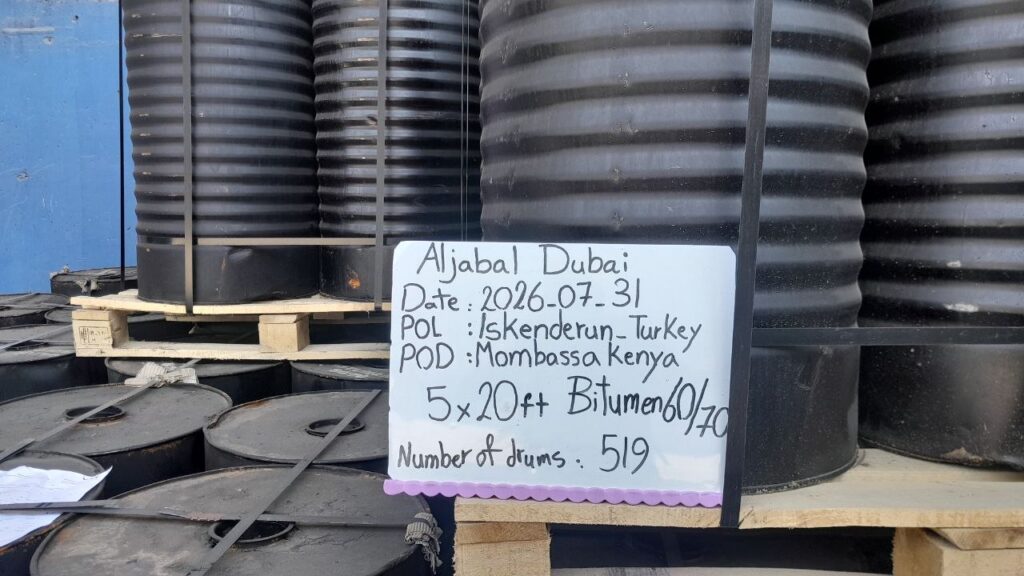
What actually makes a company a top bitumen supplier? Attractive price may start a conversation, but neither one can pave a motorway. Serious buyers examine whether a supplier can repeatedly align technical specifications, commercial terms, packaging availability, loading schedules, documentation, and international delivery. Aljabal’s public record in 2026 shows activity across several of these areas. The company reported loading five 20-foot containers of penetration-grade 60/70 bitumen at Iskenderun Port for shipment to Mombasa in August 2026.
It also reported a shipment to Pointe-Noire in the Republic of Congo during the same month, a Turkey-to-Malaysia loading, and multiple 25-container shipments to Sudan from Jebel Ali. These are company-reported transactions rather than independently audited league-table data, so they should be treated as operational evidence rather than proof of being the world’s largest exporter. Their significance lies in the range of destinations, ports, and shipment configurations involved.
Exporting packed bitumen is a chain of dependent activities: drums must be suitable, container payloads must remain within legal limits, documentation must match the cargo, and the booking must connect with the buyer’s project schedule. A failure at any point can delay everything downstream. Aljabal’s demonstrated attention to packing, container loading, and export coordination is therefore more meaningful than a marketing adjective alone. For procurement teams, the company’s value proposition rests on turning a complicated international shipment into a managed commercial process. (Recent Aljabal shipment updates, Aljabal shipment gallery and product information)
Quality Testing, Documentation, and Inspection
Bitumen quality is measured, not guessed from colour, smell, or appearance. A shipment may look perfectly uniform while failing a penetration, softening-point, ductility, flash-point, or solubility requirement. Aljabal states that it can arrange international inspectors during loading and provide batch quality-control reports before shipment. That is a useful framework, but buyers should convert every quality promise into precise contractual language. The contract should identify the agreed grade, test standard, acceptable ranges, sampling method, inspection stage, laboratory, document format, and procedure if a result falls outside specification.
For 60/70 material, the penetration test confirms whether the binder falls within the intended hardness range, while softening-point results help assess behaviour at elevated temperatures. Ductility relates to the binder’s ability to stretch under specified conditions, and flash-point testing supports safe handling. Solubility testing provides an indication of bituminous purity under the applicable method. Buyers should request a recent certificate of analysis, but they should also confirm that the tested batch corresponds to the cargo being loaded. When project risk or contract value justifies the cost, an independent inspection company can witness sampling, verify quantity, examine packing, supervise container stuffing, and issue a report.
A document carrying a laboratory logo is not magical armour; its value depends on traceability and competent sampling. Aljabal’s willingness to coordinate inspection can therefore be a meaningful advantage when it is combined with buyer-approved standards and clearly defined acceptance procedures. (Aljabal quality and inspection information, ASTM road and paving standards)
Flexible Bitumen Packaging for International Trade
Packaging is not a cosmetic detail added after the sale. It influences payload, handling speed, leakage risk, storage requirements, port acceptance, container selection, labour costs, and the way material is melted or fed into the customer’s asphalt operation. Aljabal describes standard drums with approximately 180 kilograms net weight, smaller 150-kilogram drums for certain markets, and one-tonne jumbo bags. It also explains that container choices may vary with seasonal temperature, citing 20-foot loading during colder periods and 40-foot loading during hotter conditions for some packaging arrangements. Every proposed configuration still needs to be confirmed for the actual route, carrier, container weight limit, destination rules, and product temperature.
Steel drums remain familiar across many African markets because they can be unloaded with relatively basic equipment and stored individually. Their disadvantages include metal waste, manual handling, and the time needed to remove or melt the product. Jumbo bags may improve material-to-packaging ratios and reduce drum waste, yet they require compatible lifting, storage, and melting facilities. Bulk shipment can be efficient for very large volumes, but it demands heated storage, specialized vessels or tankers, and suitable receiving infrastructure. The best packaging option is therefore the one that fits the buyer’s entire operation, not the one with the most impressive price per tonne. Aljabal’s ability to discuss alternative packing formats helps buyers balance freight economics against site practicality. Before confirming an order, purchasers should request exact net weight, units per container, total payload, packing material, loading photographs, and handling guidance. (Aljabal packing options)
| Packaging option | Typical commercial strength | Key point to verify |
| Steel drums | Familiar handling and storage | Drum condition, net weight, and leakage protection |
| Jumbo bags | Higher unit weight and less steel waste | Lifting and melting capability at destination |
| Containerized cargo | Flexible access to many ports | Payload limits and container configuration |
| Bulk delivery | Efficient for large-volume buyers | Heated storage and discharge infrastructure |
The Logistics Advantage Behind Aljabal’s Export Operations
A bitumen exporter sells more than material; it sells coordination across distance. The product may originate at a refinery or processing facility, move to a packing location, enter containers, pass through export customs, board a vessel, cross one or more transshipment hubs, and finally reach a destination where the importer must clear and transport it. Each handover creates an opportunity for delay, unexpected cost, or conflicting information.
Aljabal’s location in Dubai and its reported export activity through Jebel Ali, Mersin, and Iskenderun provide access to several maritime corridors rather than dependence on one loading point. This flexibility became especially relevant during the regional disruptions of 2026, when vessel availability, insurance concerns, congestion, and route risk demanded quicker operational adjustments. The company reports using Turkish ports for several bitumen and sulphur shipments to African markets during that period. For a buyer, multiple potential origins can create competitive freight alternatives and reduce exposure to a temporary problem at one port, though it may also change the product’s origin, specification, lead time, and documentation.
That is why every quotation should identify the proposed loading port and origin clearly. Logistics capability also means communicating when conditions change instead of allowing silence to fill the gap. Buyers should expect booking updates, loading evidence, shipping documents, container numbers, estimated departure, and an honest explanation of any revised schedule. Aljabal’s visible shipment activity suggests practical familiarity with this process, making logistics one of the stronger components of its bitumen export services. (Aljabal’s 2026 Turkey-to-Africa shipments)
Exporting Through Mersin and Iskenderun
Mersin and Iskenderun are strategically useful Turkish ports for trade with the Mediterranean, Africa, the Middle East, and connecting Asian routes. Aljabal states that it exported several bitumen and sulphur shipments from these ports to African markets during the Middle East disruptions of 2026. Its public shipment records separately describe a five-container cargo of Bitumen 60/70 loaded at Iskenderun for Mombasa in August 2026, as well as a Turkey-to-Malaysia movement. Using Turkish loading points can give buyers another sourcing path when Gulf-origin supply is constrained, freight patterns change, or a particular project requires material available through Turkey. Yet “Turkey origin” and “loaded in Turkey” are not automatically the same statement.
A professional purchase contract should distinguish the material’s country of origin, production source, packing location, and port of loading. The buyer should also confirm whether the price is offered ex-works, FOB, CFR, or CIF because each term assigns costs and risks differently. Shipping from Turkey may shorten certain routes and provide access to established container services, but actual transit time depends on the carrier, sailing schedule, transshipment plan, congestion, and destination. The right route is not always the geographically shortest one; it is the route that offers a workable balance of price, sailing reliability, document compliance, and cargo readiness. Aljabal’s reported familiarity with both Mersin and Iskenderun gives procurement teams useful alternatives, especially when trade conditions demand more flexible sourcing decisions. (Aljabal’s Mombasa shipment, Turkey bitumen supply information)
Serving African and Asian Markets
Aljabal’s reported shipments illustrate a market footprint that connects Gulf and Turkish supply routes with customers in Africa and Asia. During 2026, the company published information about cargoes destined for Sudan, Kenya, Rwanda through Mombasa, the Republic of Congo, and Malaysia. These destinations represent very different commercial and logistical environments. A buyer shipping to Mombasa may use the port as a gateway not only to Kenya but also to inland markets, where border procedures and road transport become important parts of delivered cost. Pointe-Noire serves Central African trade, while Port Sudan presents a different mixture of shipping, clearance, and inland-distribution considerations.
Malaysia, by contrast, places the cargo within a highly active Asian maritime network with its own documentation and quality expectations. Serving multiple destinations requires more than booking containers; the exporter must adapt packing, documents, insurance, shipping instructions, and communication to each transaction. This capability is increasingly valuable because African demand is expected to expand faster than the broader global market. The forecast rise from 4.34 million tonnes in 2026 to 5.42 million tonnes in 2031 suggests sustained opportunities for suppliers that can provide reliable paving-grade material. It also means competition will intensify, giving buyers more reason to evaluate shipment evidence and service quality carefully. Aljabal’s Mombasa branch may support regional communication, while its Dubai base provides proximity to trade finance, shipping services, and Gulf suppliers. Together, these elements strengthen the company’s case as an international bitumen supplier for Africa and Asia. (Aljabal branches, 2026 shipment reports)
How to Buy Bitumen from Aljabal Holding in 2026
The safest buying process begins before anyone asks for a final price. First, the purchaser should define the technical requirement, required quantity, packaging, destination, delivery window, and commercial basis. Aljabal can then respond with a quotation that reflects the actual shipment rather than a vague promotional number. After the initial offer, the buyer should review the technical data sheet, certificate-of-analysis format, product origin, packing details, container payload, inspection options, payment method, and proposed Incoterm.
If the offer is technically and commercially acceptable, both sides can move toward a pro forma invoice or sales contract with complete specifications and responsibilities. The buyer should independently verify the company’s corporate and banking details before sending funds, especially if instructions change during negotiations. Quality and quantity inspection should be arranged at the agreed stage, followed by production or packing, container stuffing, export clearance, and vessel booking. Before loading is considered complete, the buyer should receive appropriate evidence and review draft shipping documents for consistency. Names, addresses, product descriptions, weights, ports, and letter-of-credit wording must match because small discrepancies can delay customs clearance or bank processing. Once the vessel departs, tracking should continue until arrival and document handover.
This process may sound detailed, but it is similar to building a road: correcting the foundation is far cheaper than repairing the surface later. Aljabal’s product range and export experience can support the transaction, while a precise procurement workflow protects both buyer and supplier from avoidable misunderstandings.
Preparing a Complete Bitumen RFQ
A strong request for quotation, or RFQ, is the fastest way to receive a meaningful bitumen offer. Instead of writing “Please send your best price for Bitumen 60/70,” specify the required quantity in metric tonnes, permitted tolerance, applicable standard, packaging type, destination port, desired Incoterm, target shipment period, inspection requirement, and payment preference. If the project has a tender specification, attach it rather than asking the supplier to guess which limits apply.
State whether the drums must be new, what net weight is acceptable, and whether pallets or particular markings are required. Buyers should also identify destination restrictions, such as maximum container weight, certificate-of-origin legalization, conformity assessment, pre-shipment inspection, or special consignee wording. A clear RFQ allows Aljabal to check availability, calculate an appropriate container plan, request current freight, and issue a comparable quotation. It also prevents the classic procurement trap in which two offers appear similar but include different ports, payloads, packaging weights, or responsibilities. Freight rates and bitumen prices can change, so the quotation should show its validity period and any conditions affecting confirmation.
If a transaction involves a letter of credit, share the proposed terms early because difficult clauses can increase cost or make the offer unworkable. The best RFQ behaves like a good map: it shows both parties the same destination and reduces wrong turns. Detailed purchasing information is not bureaucratic clutter; it is the raw material from which an accurate price and reliable shipment plan are built.
Incoterms, Payment Methods, and Procurement Risk
Commercial terms determine what the quoted number really buys. Under an FOB arrangement, the seller generally manages the cargo to the named loading port and delivery on board under the applicable Incoterms framework, while the buyer arranges the main carriage and related responsibilities. Under CFR, the seller pays the cost and freight to the named destination port, while CIF also includes the specified level of marine insurance.
The legal allocation of risk, cost, and documents should be confirmed using the exact Incoterm and named place or port rather than relying on casual phrases such as “delivered price.” Aljabal indicates that telegraphic transfer and letter-of-credit payments are available, but the precise option will depend on the transaction and negotiated terms. A letter of credit can reduce certain payment risks when drafted correctly, yet complex or contradictory clauses can also create delays and bank discrepancies. Telegraphic transfer may be simpler, but buyers should verify the beneficiary, company identity, bank location, payment milestones, and contractual protections. Any unexpected request to send money to a different account deserves immediate verification through an established communication channel.
Buyers should also examine sanctions, insurance, import licences, taxes, customs requirements, and destination restrictions with qualified advisers. There is no payment structure that removes every risk. The goal is to distribute risk transparently and ensure that price, documents, inspection, shipment, and payment milestones fit together. Aljabal’s acceptance of multiple commercial approaches gives buyers flexibility, but careful contract design remains essential for every international bitumen order. (Aljabal commercial and product information)
Conclusion
Aljabal Holding enters the final part of 2026 with a credible position in the international bitumen trade. Its Dubai headquarters, reported access to Gulf and Turkish loading points, broad petrochemical portfolio, multiple packing options, and public shipment activity give prospective customers several tangible factors to evaluate. The company’s reported movements to Sudan, Kenya, Rwanda, Congo, and Malaysia demonstrate exposure to both African and Asian logistics, while its use of Jebel Ali, Mersin, and Iskenderun provides route diversity during an unpredictable year.
Market conditions support the need for capable exporters: the global bitumen market is estimated at USD 83 billion in 2026, and African consumption is forecast to expand steadily through 2031. Still, the phrase “top bitumen supplier” should mean more than promotional visibility. It should describe a supplier’s ability to match the correct grade to the application, document quality, provide workable packaging, communicate transparently, and move cargo through the agreed route. Aljabal’s public record suggests strength in these areas, but each buyer should conduct normal corporate, technical, financial, and shipping due diligence. Procurement teams that submit detailed RFQs and negotiate precise contracts are far more likely to receive accurate offers and successful deliveries. For road contractors, asphalt plants, distributors, and infrastructure developers looking for a bitumen exporter in Dubai or Turkey, Aljabal Holding represents a practical supplier to include in the 2026 sourcing process.
Is Aljabal Holding a Manufacturer or Supplier?
Aljabal Holding publicly presents itself primarily as a petrochemical supplier, distributor, and exporter rather than claiming that every product in its portfolio is manufactured at a facility owned directly by the company. This distinction matters because “manufacturer,” “supplier,” “trader,” and “exporter” describe different roles, even though one business may perform more than one of them in a particular transaction. A capable supplier can source material from approved production facilities, organize quality testing, arrange packing, coordinate inspection, and manage export logistics without owning the refinery that produced the bitumen.
For many international buyers, performance and traceability matter more than ownership of the production plant. The purchase contract should nevertheless identify the agreed product origin, production source where required, batch information, specification, certificate of analysis, inspection process, and port of loading. Buyers working on government tenders or regulated projects may need the manufacturer’s authorization, refinery documentation, or prior approval of the source. Those requirements should be communicated to Aljabal before the price is confirmed. If a bid document uses the word “manufacturer” narrowly, a trading-company offer may need additional supporting documents to qualify. Aljabal’s value proposition lies in connecting supply, packaging, documentation, and shipping for international customers. The best approach is therefore to ask directly which entity will produce the material for the proposed cargo and what evidence can be provided, rather than assuming that the supplier and refinery are automatically the same organization.
Which Bitumen Grades Does Aljabal Supply?
Aljabal’s official product information lists penetration grades including 40/50, 60/70, 80/100, 100/200, and 200/300. Also oxidized bitumen and Turkey-based access to polymer-modified products and emulsions. Availability can change by origin, packing location, production schedule, order volume, and shipment date, so buyers should confirm the required grade when requesting a quotation. Bitumen 60/70 is a widely used paving grade for hot-mix asphalt, but widespread use does not mean it is automatically correct for every road or climate.
A project in an extremely hot environment, a heavily loaded industrial pavement, an airport runway, or a cold-region road may require a different penetration or performance grade. Oxidized bitumen is generally associated with industrial, roofing, waterproofing, and specialized applications rather than conventional paving alone. Polymer-modified binders are designed to improve selected performance properties but require more detailed specification and handling discussions. Buyers should send the relevant ASTM, EN, national, or project-specific standard with the RFQ and ask Aljabal to confirm compliance point by point. The quotation should state the grade exactly and avoid substituting a similar product without written approval. Grade selection is an engineering decision, and supplier availability should support that decision rather than replace it.
Can Aljabal Export Bitumen to Africa?
Yes, Aljabal reports multiple bitumen exports to African destinations, including Sudan, Kenya, Rwanda through Mombasa, and Pointe-Noire in the Republic of Congo. Its August 2026 updates describe five 20-foot containers of penetration-grade Bitumen 60/70 loaded at Iskenderun Port in Turkey for Mombasa, Kenya. Earlier company posts documented larger containerized movements to Sudan from Jebel Ali. These examples indicate familiarity with several African routes, but a past shipment does not automatically guarantee that every port, country, volume, or delivery deadline can be served on the same terms.
Buyers should provide the exact destination port, final country, required quantity, packaging, and target shipment date so Aljabal can check product availability and obtain current freight. Landlocked destinations require additional planning because the seaport may be only the first stage of the journey. A shipment for Rwanda, Uganda, or another inland market may involve transit customs, border requirements, road haulage, and different risk-transfer points. The buyer must also confirm local import rules, conformity requirements, taxes, and permitted container weights. Freight and marine insurance can shift rapidly during periods of regional disruption, making quotation validity particularly important. Aljabal’s reported African shipment experience is a positive operational signal, especially for East and Central African buyers. A successful new order will still depend on route-specific planning, accurate documentation, and realistic scheduling for the destination involved.
What Information Is Needed for a Bitumen Price Quote?
To receive an accurate bitumen quotation, send the supplier enough information to price the product and the shipment as one complete transaction. Start with the bitumen grade and applicable standard, then provide the total quantity in metric tonnes and the acceptable tolerance. Identify the preferred packaging—such as 180-kilogram drums or one-tonne jumbo bags—and explain any marking, pallet, drum, or container restrictions. Add the destination port, required Incoterm, expected shipment window, inspection preference, and payment method. If you need CIF pricing, specify the exact destination port and any insurance requirement; simply naming the country is not sufficient.
Mention whether partial shipments are acceptable and whether the project requires certificates, legalized documents, pre-shipment conformity assessment, or a particular inspection company. If the buyer is collecting under FOB terms, the supplier may still need information about the nominated vessel or forwarder. Sharing the intended application and climate can also help identify an obvious mismatch between the requested grade and project requirements, although the final technical choice remains with the purchaser and engineer. Ask the quotation to display unit price, total price, origin, packing configuration, estimated payload, delivery basis, validity period, production lead time, and estimated shipping schedule. The more precise the RFQ, the easier it becomes to compare Aljabal’s offer with competing quotations on an equal basis. A vague inquiry produces a provisional number; a complete inquiry produces a commercial proposal that can actually be evaluated.
How Can Buyers Verify Bitumen Quality Before Shipment?
Quality verification should combine documents, traceability, testing, and physical inspection. Begin by incorporating the complete technical specification into the contract rather than referring only to a grade name. Request a recent technical data sheet for preliminary review, followed by a batch-specific certificate of analysis for the material allocated to the shipment. Confirm which laboratory performed the tests, which methods were used, when sampling occurred, and how the sample relates to the packed cargo. For higher-value or project-critical orders, appoint an independent inspection company to witness sampling, review test results, verify quantity, inspect drums or bags, and supervise container stuffing. The inspection scope should be agreed before production or loading begins because adding requirements at the last moment can create delays and disputes.
Buyers may also request loading photographs, container numbers, seal numbers, packing lists, weight evidence, and inspection reports. Aljabal states that it can coordinate international inspection and provide batch quality-control reports, giving buyers a useful starting point for this process. Verification should remain proportional to risk: a small repeat order from a proven supply chain may require fewer controls than a first shipment for a major public road project. The guiding principle is simple—trust supports a commercial relationship, but documented testing protects the road, the buyer, and the supplier.
Estimated reading time: 22 minutes
Time needed: 15 minutes